
Dedicated Servers for Real-Time Data Processing: What You Need to Know
In today’s digital-first business environment, speed is no longer just a performance advantage. It is a necessity. From financial trading platforms and healthcare systems to logistics dashboards, gaming platforms, AI applications, and analytics tools, many businesses now depend on real-time data processing to make instant decisions. Even a few seconds of delay can affect customer experience, business accuracy, and operational efficiency.
This is where dedicated servers play an important role. Unlike shared hosting or basic virtual environments, dedicated servers provide complete access to physical server resources. The CPU, RAM, storage, and network capacity are assigned to one user or one organization. This makes them suitable for applications that require high performance, consistent speed, better control, and strong reliability.
For businesses running data-intensive applications, choosing the right dedicated server hosting environment can directly impact how fast data is received, processed, stored, and delivered. Real-time systems need infrastructure that can handle continuous workloads without slowing down during peak traffic or heavy usage.
What Is Real-Time Data Processing?
Real-time data processing is the act of gathering, analysing and responding to data nearly immediately after it has been created. Real-time systems process data immediately, rather than storing it and analyzing it later.
For example, an online payment gateway must approve transactions in real-time. A stock trading platform needs to process changes in the market in milliseconds. A logistics company needs live truck monitoring data to be updated. The healthcare monitoring system should be able to detect problematic patient readings without delay.
These applications need low reaction times, dependable server performance and permanent connectivity. If the server is slow, overloaded or unreliable the whole system may not be able to provide correct results in real time.

Why Dedicated Servers Are Suitable for Real-Time Data Processing
Real-time applications require more than just basic hosting. They need stable computing power, low latency, fast storage, and predictable performance. High-performance dedicated servers are designed to deliver these benefits because they do not share resources with other users.
In shared environments, one user’s high traffic can affect another user’s performance. In real-time data processing, this kind of inconsistency is risky. Dedicated servers remove this problem by giving businesses full control over hardware resources.
With dedicated infrastructure, businesses can configure the server based on their exact workload. They can choose the right processor, memory, storage type, operating system, database setup, and security rules. This level of control is important for applications where performance cannot be left to chance.
Low Latency Matters for Real-Time Applications
Latency is the time it takes from request to response. For normal websites, a minor delay could just be a user experience issue. But latency can impact business outcomes for real-time data processing applications.
For example, low latency servers might be useful for executing transactions quickly in banking applications. In gaming, lower latency means a better player experience. Faster connection enables devices to respond quickly in IoT networks. Live analytics dashboards let teams make faster decisions with real-time updates.
Dedicated servers can be configured to reduce latency by using strong processors, fast network ports and efficient databases, as well as data center locations closer to the end users. You also need to select the proper server location as the actual location of the user and server can impact response time.
Better Performance for Data-Intensive Applications
In real time data processing, the amount of incoming data is often huge. These can be user activity logs, sensor data, payment requests, application events, live chat data, video streams, or machine-generated data.
Heavy processing is required by these workloads. Dedicated servers provide improved performance as all resources are dedicated to a workload. Multi-core CPUs, more RAM, NVMe storage and better network connectivity enable you to process data faster.
For applications that include huge data processing, specialized infrastructure allows for additional customisation. Teams can install specialized database engines, caching tools, queue systems, monitoring software, and analytic frameworks. This enhances speed and reliability.
Dedicated Servers vs Shared Hosting for Real-Time Workloads
Shared hosting is ideal for tiny websites, blogs and simple company pages. It’s not the best for processing data in real time, though. Shared hosting offers limited resources, limited access to the server, and uncertain performance as several users rely on the same server.
Dedicated servers are separate things. They give you dedicated resources and full control over the server. This makes them more ideal for mission-critical applications, enterprise software, SaaS platforms, trading systems, ERP tools and live monitoring dashboards.
For example, shared hosting could go down during high-traffic times if your application needs to process thousands of events per minute. A dedicated server can manage this kind of workload more efficiently as the hardware is not shared with unknown users.
Storage Speed Is Important
Real-time applications do not only depend on CPU and RAM. Storage also plays a major role. When data is written, read, analyzed, and retrieved continuously, slow storage can create bottlenecks.
Modern dedicated servers with SSD or NVMe storage are better suited for real-time workloads. NVMe storage offers faster read and write speeds compared to traditional HDDs. This helps databases respond faster and allows applications to process requests with less delay.
For applications such as analytics platforms, trading systems, CRM tools, monitoring dashboards, and large eCommerce platforms, fast storage can improve overall performance significantly.
Scalability for Growing Data Needs
As businesses grow, their data also grows. A real-time application that starts with a small number of users may later need to handle thousands or millions of requests. That is why scalable server resources are important.
Dedicated server hosting gives businesses the flexibility to upgrade hardware resources when needed. CPU, RAM, storage, bandwidth, and backup options can be planned based on growth. Some businesses may start with one dedicated server and later move to a multi-server setup with load balancing, database separation, and backup nodes.
Scalability ensures that the application continues to perform well even when traffic increases. Without proper scaling, real-time systems can slow down, crash, or lose data during peak usage.
Security Benefits of Dedicated Servers
Real-time data processing applications often handle sensitive information. This may include financial data, customer records, business analytics, medical data, or private user activity. Security is therefore a major requirement.
Dedicated servers provide better security control compared to shared hosting. Since the server is not shared with other unknown users, the risk of cross-account attacks is reduced. Businesses can apply their own firewall rules, access control policies, malware scanning, intrusion detection, and backup strategies.
Server security can also be improved with regular updates, SSH hardening, DDoS protection, secure database configuration, SSL certificates, and monitoring tools. For industries that require compliance or strict data handling practices, dedicated infrastructure gives more control over security settings.
Uptime Reliability for Critical Systems
Real-time applications must be available whenever users need them. Downtime can affect business operations, customer trust, and revenue. For example, if a payment processing system goes offline, transactions may fail. If a logistics tracking system stops working, live shipment updates may be delayed.
Dedicated servers are often preferred for applications that require uptime reliability. Since resources are not shared, performance is more stable. Businesses can also configure backup systems, failover options, monitoring alerts, and disaster recovery plans.
A reliable hosting environment should include strong network connectivity, quality hardware, regular monitoring, and quick support response. These factors help reduce the risk of downtime and improve application availability.
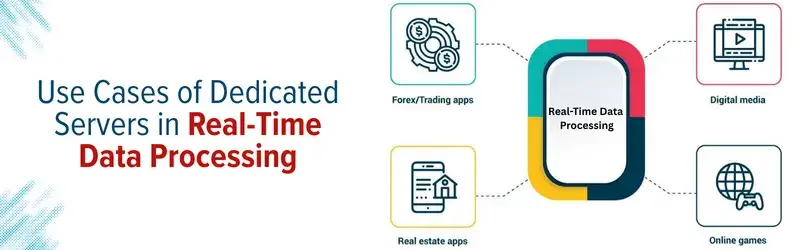
Use Cases of Dedicated Servers in Real-Time Data Processing
Dedicated servers can support many types of real-time applications across industries.
Financial Applications
Trading platforms, payment gateways, accounting systems, and fraud detection tools require fast and accurate processing. Even small delays can affect transactions and decision-making. Dedicated servers help provide the speed and stability needed for financial workloads.
Healthcare Systems
Healthcare applications may process patient monitoring data, appointment updates, medical records, and diagnostic information. Real-time access to accurate data can support faster decisions and better patient care.
Logistics and Fleet Tracking
Logistics companies use real-time data to track vehicles, delivery status, routes, fuel usage, and driver activity. Dedicated servers can help process live GPS data and update dashboards quickly.
Gaming Platforms
Online gaming needs low latency and stable server performance. Delays can impact gameplay and user experience. High-performance dedicated servers are often used for multiplayer gaming environments and game hosting.
IoT Applications
IoT systems collect data from connected devices such as sensors, machines, cameras, and smart equipment. Dedicated infrastructure helps process large streams of device data in real time.
SaaS and Business Applications
SaaS platforms, CRM systems, ERP software, and analytics dashboards need consistent speed for multiple users. Dedicated servers help maintain stable performance during heavy usage.
How to Choose the Right Dedicated Server
Choosing the right dedicated server for real-time data processing depends on the application workload. Businesses should consider several factors before selecting a server.
The processor should be powerful enough to handle continuous calculations and multiple requests. RAM should be sufficient for databases, caching, and application services. Storage should be fast, preferably SSD or NVMe, especially if the application performs frequent read/write operations.
Bandwidth and network speed are also important. Real-time systems need stable connectivity and low packet loss. The server location should be selected based on the target audience or operational region to reduce latency.
Security options, backup availability, operating system support, monitoring tools, and technical support should also be reviewed before finalizing the server.
Dedicated Servers and Database Performance
Most real-time applications depend heavily on databases. Whether the system uses MySQL, PostgreSQL, MongoDB, Redis, or another database engine, server performance directly affects database speed.
Dedicated servers allow better database optimization. Businesses can tune memory usage, storage configuration, indexes, caching layers, and query performance. They can also separate application and database workloads if needed.
For high-volume applications, using dedicated resources for the database can improve stability and reduce query delays. This is especially helpful for analytics platforms, financial systems, reporting tools, and live dashboards.
Why Control Matters
One of the main advantages of dedicated servers is control. Businesses can choose how the server is set up, secured, optimized, and maintained. This is significant since real-time data processing applications typically have special requirements.
Some applications may require bespoke software stacks. Others could need specific versions of databases, specific firewall rules, or tools for background processing. Dedicated servers allow you to construct an infrastructure that meets your exact application need.
Such level of control is not always achievable in shared hosting or restricted managed environments.
Final Thoughts
Real-time data processing applications need infrastructure that is fast, stable, secure, and scalable. Basic hosting may work for small websites, but it is not enough for systems that must process live data continuously.
Dedicated servers provide the performance and control required for real-time workloads. With dedicated CPU, RAM, storage, and network resources, businesses can build reliable applications that respond quickly and handle high-volume data efficiently.
For companies working with analytics, finance, healthcare, logistics, gaming, IoT, SaaS, or enterprise applications, dedicated server hosting can provide a strong foundation. The right server setup can reduce latency, improve uptime, strengthen security, and support future growth.
As real-time data becomes more important across industries, choosing high-performance dedicated servers is not just a technical decision. It is a business decision that can directly impact speed, customer experience, and operational success.