ERPNext Hosting: A Beginner’s Guide to Hosting ERPNext for Your Business
Running a business is exciting, but managing daily operations can quickly become messy. Sales, accounts, HR, inventory, purchases, projects, CRM, and customer support often end up scattered across different tools. One team uses Excel, another uses accounting software, someone tracks leads on WhatsApp, and the owner keeps asking for reports that take hours to prepare.
This is exactly where ERPNext comes into the picture.
ERPNext is an open-source ERP software that helps businesses manage multiple departments from one central platform. But to use ERPNext properly, you need a reliable place to install and run it. That place is called ERPNext hosting.
In this beginner’s guide, let’s understand what ERPNext hosting means, how it works, which hosting type is suitable, and why many businesses prefer ERPNext VPS hosting for better performance and control.
What is ERPNext?
ERPNext is a business management software, also known as an ERP system. ERP stands for Enterprise Resource Planning. In simple words, it helps you manage your business operations in one place.
With ERPNext, you can manage:
- Accounting and invoices
- Sales and purchase orders
- Inventory and stock
- CRM and leads
- HR and payroll
- Projects and tasks
- Manufacturing
- Helpdesk and support
- Website and eCommerce functions
The best part is that ERPNext is open-source. This means businesses can use it, customize it, and scale it based on their requirements without depending on expensive closed software systems.
ERPNext is widely used by startups, SMEs, manufacturers, traders, service companies, educational institutions, and growing businesses that want a structured system for operations.
What is ERPNext Hosting?
ERPNext hosting means running ERPNext on a server so that your team can access it through a browser from anywhere. Instead of installing ERPNext only on one local computer, hosting allows the software to work online.
Your team can log in using their username and password, access modules based on permissions, create invoices, manage stock, update customer details, and generate reports in real time.
The hosting server stores your ERPNext files, database, user data, attachments, backups, and system configurations. So, the quality of your hosting directly affects how fast, secure, and stable your ERPNext application will be.
Why Does ERPNext Need Good Hosting?
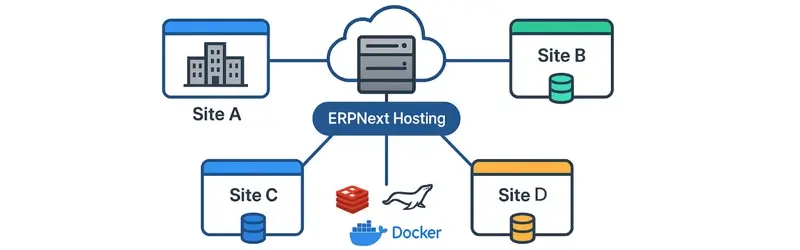
ERPNext is not like a simple static website. It is a full business application with many moving parts. It uses a backend framework, database, background workers, cache system, scheduler, file storage, and email functions.
When multiple users access ERPNext at the same time, the server has to process many requests. For example, one user may create a sales invoice, another may upload a purchase bill, the accounts team may generate reports, and the inventory team may update stock.
If the server is weak, the system becomes slow. This can affect productivity and frustrate users.
Good ERPNext hosting helps with:
- Faster page loading
- Smooth multi-user access
- Better database performance
- Reliable backups
- Secure access
- Higher uptime
- Easy scaling when business grows
Different Types of ERPNext Hosting
There are different ways to host ERPNext. The right option depends on your business size, budget, technical knowledge, and future growth plans.
1. Shared Hosting
Shared hosting is usually used for small websites. Multiple users share the same server resources. It is affordable, but it is not suitable for ERPNext.
ERPNext needs background services, database access, Python environment, Redis, Node.js, workers, and command-line-level configuration. Most shared hosting environments do not support these properly.
So, for ERPNext, shared hosting is generally not recommended.
2. VPS Hosting
A VPS, or Virtual Private Server, gives you dedicated resources inside a virtual environment. You get your own CPU, RAM, storage, operating system, and root access.
This makes ERPNext VPS hosting one of the most practical choices for small and medium businesses. It gives better performance than shared hosting and is more affordable than a dedicated server.
With VPS hosting, you can install ERPNext, configure the required services, manage backups, set up SSL, and scale resources as your users increase.
3. Dedicated Server Hosting
A dedicated server gives you an entire physical server for your business. This is ideal for larger companies, high-traffic ERP systems, or businesses with heavy database usage.
Dedicated servers offer maximum performance and control, but they also cost more. For most growing businesses, a VPS is enough at the beginning. A dedicated server can be considered later when the usage becomes heavy.
4. Managed ERPNext Hosting
In managed ERPNext hosting, the hosting provider helps with server setup, security, monitoring, backups, updates, and technical maintenance.
This is useful for business owners who do not want to manage server commands, Linux configuration, firewall rules, or ERPNext installation issues. You get the benefit of ERPNext without spending time on server-level tasks.
Why ERPNext VPS Hosting is a Smart Choice
For most businesses, ERPNext VPS hosting offers the right balance between price, performance, and flexibility.
Unlike shared hosting, a VPS gives you dedicated resources. Your ERPNext performance does not depend heavily on other users. You also get better control over server settings, which is important because ERPNext needs a proper technical environment.
Better Performance
ERPNext depends heavily on database and background processes. A VPS with enough RAM, CPU, and SSD/NVMe storage can improve loading speed and reduce delays.
Full Control
With VPS hosting, you get root access. This allows ERPNext to be installed and configured properly with all required dependencies.
Easy Scalability
As your business grows, you may add more users, more invoices, more products, more attachments, and more reports. A VPS can be upgraded with higher RAM, CPU, or storage when needed.
Improved Security
Since your ERPNext runs in an isolated server environment, you get better control over firewall rules, SSL certificates, user access, backups, and security updates.
Cost-Effective Setup
A VPS gives strong performance without the higher cost of a dedicated server. This makes it ideal for startups, SMEs, and growing companies.
Basic Server Requirements for ERPNext Hosting
The exact server requirement depends on the number of users and business usage. A small company with 5 users will not need the same resources as a company with 100 users.
For a basic ERPNext setup, you can consider:
- 2 CPU cores
- 4 GB RAM
- 40 GB SSD/NVMe storage
- Ubuntu server
- Root access
- Regular backup system
- SSL certificate
- Stable internet and uptime
For better performance, especially if you have multiple users, large inventory, accounting data, reports, and attachments, choosing higher RAM and faster storage is recommended.
Benefits of ERPNext Hosting for Businesses
A properly hosted ERPNext system can change how your business works daily.
Centralized Business Data
All departments work from one system. Sales, accounts, inventory, HR, and management can access updated data without depending on separate files.
Real-Time Reports
Business owners can check sales, receivables, payables, stock value, profit, and performance reports instantly.
Better Team Collaboration
Since ERPNext is browser-based, users from different locations can work together in the same system.
Reduced Manual Work
ERPNext reduces repeated manual entries. For example, a sales order can be converted into a delivery note and invoice, saving time and reducing errors.
Better Customer Management
With CRM, quotations, invoices, support tickets, and communication history in one system, customer handling becomes more organized.
Long-Term Cost Savings
Since ERPNext is open-source, businesses can avoid high software license costs. The main investment is hosting, setup, customization, and maintenance.
Managed vs Unmanaged ERPNext Hosting
When choosing ERPNext hosting, you should also understand the difference between managed and unmanaged hosting.
In unmanaged hosting, you get the server, but installation, security, updates, and troubleshooting are your responsibility. This is suitable if you have a technical team.
In managed ERPNext hosting, the hosting provider assists with technical server management. This is better for business owners who want peace of mind and do not want to handle Linux commands, server errors, or performance issues.
Important Things to Check Before Choosing ERPNext Hosting
Before selecting an ERPNext hosting provider, check these points carefully:
- Does the server support ERPNext installation requirements?
- Is SSD or NVMe storage available?
- Can server resources be upgraded later?
- Is backup support available?
- Is SSL included or supported?
- Is technical support available when needed?
- Is the server location suitable for your users?
- Does the provider understand business application hosting?
Who Should Use ERPNext Hosting?
ERPNext hosting is suitable for businesses that want more control and structure in daily operations.
It is useful for:
- Trading companies
- Manufacturing businesses
- Service providers
- Retail and distribution businesses
- Educational institutions
- Healthcare-related businesses
- Startups and growing SMEs
- Agencies and IT companies
- Businesses moving away from Excel-based management
Why Choose VPS9 for ERPNext Hosting?
VPS9 offers VPS hosting solutions that can be used for hosting business applications like ERPNext. With VPS-based infrastructure, businesses get better control, dedicated resources, and the flexibility required for ERPNext deployment.
For businesses that want performance, scalability, and reliable server access, VPS9 can be a strong choice for ERPNext VPS hosting. You can start with a VPS plan based on your current usage and upgrade as your ERPNext users and data grow.
Whether you are setting up ERPNext for a small team or planning a more advanced business management system, choosing the right hosting foundation is important from day one.
Final Thoughts
ERPNext is a powerful tool for businesses that want to organize operations, improve reporting, and reduce manual work. But the software is only as reliable as the server it runs on.
Good ERPNext hosting ensures that your system remains fast, secure, and available when your team needs it. For most businesses, ERPNext VPS hosting is the best starting point because it offers dedicated resources, full control, scalability, and cost efficiency.
If you are planning to use ERPNext for your business, start with the right hosting setup. A stable ERPNext server today can save you from performance issues, downtime, and migration headaches tomorrow.