
Introduction
Choosing a domain name is one of the most important first steps when creating a website – whether it is a blog, business, online shop, or portfolio – but even beyond the name, is deciding which Top-Level Domain (TLD) to use, which most people overlook.
There’s the traditional “.com” to newer and trendy “.store” or “.tech“. Deciding on a TLD will have an impact on your brand (or limitation), your search engine visibility, and the overall perception of your website.
In this blog, we will help you understand what TLDs are, how they influence your hosting strategy, and what options will fit your business in 2026. Whether you are buying your first domain or transferring domains to a new host, this blog will help you make an informed decision.
What is a Top-Level Domain?
A Top-Level Domain (TLD) is what comes at the end of a domain name in a website URL, after the last dot. For example, in www.mybusiness.com the last part, “.com,” is the TLD. The TLD functions as a category or an extension to define either the purpose of your website or the geographical area of your website. TLDs are managed and regulated by the organization, ICANN (Internet Corporation for Assigned Names and Numbers).
While the TLD does not ultimately dictate how a host functions, the TLD is very important to your online identity. A TLD helps visitors know a little bit about your site, whether it’s a business, whether it’s a non profit, or a personal blog. TLDs also change domain availability, branding options, even Domain Authority of search engines.
The Different Types of TLDs Explained
Since the initial internet launch, TLDs (top-level domains or domains) have come a long way since the days of only .com, .org, or .net. In fact, there are now 100s of TLDs and they fall into a few major categories.
The first are generic TLDs — like .com, .net and .org. These TLDs are for anyone to register, and are the TLDs used most on the web. Of these, .com is still the most trusted and popular extension for a domain, especially for a business site or an eCommerce website.
The second are country-code TLDs — tied to certain countries, such as .in for India, .uk for the United Kingdom, or .ca for Canada. These are excellent for any business targeting a regional or local audience. Utilizing a ccTLD can actually improve your local SEO, and help your site stay visible in keyword searches for that country.
Sponsored TLDs are more limited, usually designated for government agencies, educational institutions, or other organizations. Examples here are .gov, .edu, and .mil, and the general public cannot register these.
Over the past few years, there has been an influx of new generic TLDs, such as .online, .shop, .tech, and .xyz. These extensions allow users the flexibility of choosing a domain name related to their brand that is still available. As the .com domain becomes more saturated, new gTLDs are becoming more popular, particularly of startups, tech brands, and niche companies.
Why Your TLD Choice Matters for Hosting and SEO
Although your web host provides the speed, security, and uptime of your website, your TLD impacts how people discover and interact with your site. For example, if you’re launching a new site, using .com or .org instead of another TLD provides a sense of trust and authority with an audience that is familiar with domain endings that have been around for decades. This trust can reduce bounce rates and increase user retention on your website.
There are other factors to consider when using any Top-Level Domain. Using a country-code TLD (ccTLD) can improve your performance when targeting a specific geographic area. A country-code TLD helps to indicate to search engines what geographic area (and content) they should rank your website for. For example, if you’re a Delhi bakery using a .in domain name and a reputable Indian web hosting company, you’re likely to experience better search engine results from relevant searches performed in India.
How to Choose the Right TLD for Your Website
When picking TLD, it might help to reflect on your brand, audience, niche, and any growth plans you have for the future. If you are starting a business or building an eCommerce site, choosing .com is still the most popular and safest option when competing on a global scale.
However, if your brand name is already taken under .com, you can choose to use a new domain extension like .shop, .store, or .biz to keep your brand intact and not settle with a subpar domain name. Domain extensions like these are commonly used in eCommerce hosting plans, which often come with a domain name at sign up.
For a tech company, you will see more options and familiarity to use extensions like .tech, .io, or .ai as they have become common – and widely recognized – options in the tech space. For content creators or bloggers, existing with a domain like .me or .blog can better represent yourself and personalise your site.
What matters most in this decision is to choose a TLD that serves your needs and instinctively resonates with your audience. Most of the best domain hosting providers allow you to access the TLD you want at various prices, so it’s worth analyzing your options and comparing them before you register.
Popular TLDs in 2026
As we embrace the latter portions of 2026, the most popular TLDs continue to change. Some of the most used TLDs and most searched TLDs in 2023 include the following:
- com – The best domain extension, still the gold standard for business and personal brand.
- .net – Mostly used by services businesses and tech infrastructure niche.
- .org – Excellent for not-for-profits or community-based projects.
- .co – Short, startup-friendly domain extension that is often taken when .com is unavailable.
- .ai – Quickly gaining traction amongst artificial intelligence startups.
- .in – Commonly used by Indian businesses and individuals.
- .store – A good choice for eCommerce brands and online retailers.
- .online – Flexible and generic enough that any website would fit into an online extension.
These TLDs can be found through just about every top web hosting platform, multiple web hosting providers will also include a free domain registration for the first year with their annual web hosting plans.
Registering a Domain Name with the Right TLD
Establishing your online presence for your domain is more accessible than ever, especially with many domain hosting companies’ bundled plans. After you’ve chosen a domain name and the TLD you want, visit a domain registrar or web hosting service that offers domain services.
Companies like Bluehost, Hostinger, GoDaddy and Namecheap allow you to easily search for domain name availability and compare pricing on TLDs and get your registration done in a matter of minutes. I recommend you register your domain for more than one year if you can; not only for your convenience but also to build domain authority with search engines.
Don’t forget to check the box for domain privacy protection (also referred to as WHOIS privacy) which hides your personal contact info from the public record. This is normally offered as an add-on attesting the point of registration, so it is a small investment to avoid unsolicited inquiries and spam.
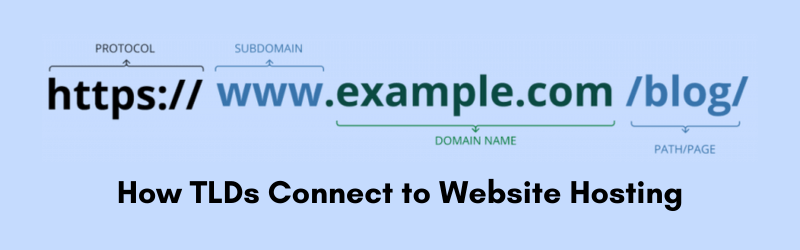
How TLDs Connect to Website Hosting
While your TLD doesn’t affect the technical performance of your web hosting, it does play a part in how your audience interacts with your site. Hosting companies often offer better management tools and support when working with common TLDs like .com, .net, or country-specific ones.
If you’re using a managed vps hosting service, for instance, your domain is integrated into your hosting control panel, making it easier to manage DNS settings and SSL certificates. Some premium TLDs may require additional verification or come with restrictions, so make sure your hosting provider supports the TLD you want to use.
Additionally, if you plan to purchase multiple TLDs to protect your brand—like owning both yourbrand.com and yourbrand.store — make sure your host supports domain forwarding and multiple domain management.
The Future of TLDs and Hosting
As the digital landscape continues to expand, we will see even more changes in the domain name industry. There will be new TLD, especially in niche industries like crypto, health, and education. TLD like .crypto, .health or .design are capturing the attention of niche audiences and will continue to do so.
More people will shift to more creative domain names as .com becomes more saturated, and while some hosting platforms have expanded their usage of AI to suggest domain names, users will establish best practices in determining their TLD and brand.
With advances in voice search and mobile-first indexing, short, easy to say domain names with easy to understand TLDs will be even more valuable in relation to online visibility.
ConclusionTop-Level Domains are not just the ending of your website address, they are an indication of your brand identity, trustworthiness and market focus. As it relates to web hosting and domain registration, the right TLD can give you a better opportunity to be found online, increase consumer trust and distinguish yourself from competitors in this new digital economy.
Your TLD choice may be a benign .com or a new age option such as .tech or .online and it should reflect your business goals and audience and purpose. Obtaining a reliable hosting services bundle with the domain + hosting would put you in a position at the beginning of your journey to have success.
After maturing through 2026 and building upon best practices for TLD trends and domain hosting, you can create a stronger more professional online presence that works, looks and performs well.